


News
PALMA SOLUTIONS JSC
Sustainable Lighting: Solar-Powered Streetlights
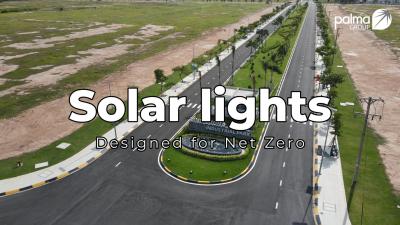
In the global context of accelerating emission-reduction goals and developing smart urban infrastructure, lighting has become one of the pioneering sectors to be “greened.” In Viet Nam, urban areas, industrial parks (IPs), and major tourism developments are gradually shifting toward sustainable lighting. Solar-powered streetlights are emerging as a breakthrough solution that helps reduce Scope 2 emissions and enhance safety, driven by Net Zero 2050 commitments and ESG requirements from international investors.
However, technical and cost-related barriers still make many developers hesitant. Most businesses want a green solution but often worry about questions such as: “Will it be bright enough?”, “Are the batteries durable?”, “Will it cost more?”
Importantly, with the strong development of manufacturing technologies and materials, the production cost of solar streetlights has been steadily decreasing. Meanwhile, traditional lighting systems have become more expensive due to rising material and infrastructure costs. At the same time, the investment cost of solar streetlight poles has become comparable to, and in many projects even lower than, traditional LED lighting.
It should be noted that conventional LED lighting infrastructure includes electrical cabling systems, undergrounding costs, control cabinets, transformers, and accompanying auxiliary components. These factors significantly increase total initial cost.
In addition, when considering operational and maintenance expenses, solar streetlights are even more advantageous: they incur no grid electricity cost, and maintenance expenses are 3-4 times lower than those of traditional systems. Smart charge-discharge controllers and optimized lighting-cycle algorithms have thoroughly addressed concerns regarding durability, performance, and other technical factors, while modular separated-component designs help reduce electronic waste.
Real-world effectiveness has been demonstrated globally and in Viet Nam: projects such as CaraWorld Cam Ranh and NovaLand’s resort chains have adopted solar lighting systems to meet ESG criteria and enhance landscape experiences.
For Frasers Property, at industrial parks such as Yên Phong and Yên Mỹ - regions with low solar irradiation and long winters - the hybrid solution (supplemented with grid electricity) has been implemented to ensure continuous and stable roadway lighting. Meanwhile, Intel’s factory in Viet Nam has applied Palma’s hybrid solution to replace traditional lighting while still maintaining operational performance regardless of weather conditions.
Looking ahead, the solar lighting industry will continue to evolve along three core directions: circular economy, science-and-technology integration, and the development of advanced materials (LiFePO₄ batteries, AI-enabled charge - discharge control). Solar-powered streetlights are forecast to become the dominant green lighting trend for 2025-2030.
Act now! If you are managing a project and want to assess the feasibility of solar lighting solutions, Palma’s team is ready to support detailed technical-financial analysis and share real-world case studies.
Message us today for expert consultation.
03/12/2025 00:04:03
News other
_-08-01-2026-23-54-30.jpg "Why can the same solar technology deliver different performance across industrial plants?")


![[PALMA x NOVALAND] WORKSHOP ON MAINTENANCE AND SERVICING OF SOLAR LANDSCAPE LIGHT PLL-30 AT NOVA HILLS – MUI NE](https://www.palma.com.vn/upload/z3634653067260_15cb1f4d62b14f3a684fdf4ee9de4870_-11-08-2022-13-55-36.jpg "[PALMA x NOVALAND] WORKSHOP ON MAINTENANCE AND SERVICING OF SOLAR LANDSCAPE LIGHT PLL-30 AT NOVA HILLS – MUI NE")
_-06-02-2026-14-31-59.jpg "Understanding kWp and kWh: The First Step Toward Effective Solar Investment")
Search
Breaking news

_-24-10-2021-21-55-01.png "MicrosoftTeams-image (8)_-24-10-2021-21-55-01.png")
_-21-04-2022-13-38-01.png "PALMA SOLUTIONS JSC")
CONTACT US
MAP
Copyright © 2020 PALMA SOLUTIONS JSC
